Showing posts with label VIDEO. Show all posts

Sunday, December 21, 2014

102. How to get in the Star-Architect Staffers Club©


Even though it is not defined by brick and morter walls The Starchitect Staffers Club is guarded by bouncers at the gate and is every bit as real as the club that Bruno infiltrated in the clip above. In fact, it is similar to it in more ways than you can imagine.

 
In my previous series, I revealed the existence of the Starchitect Staffers Club©: An inter-star-office-employee-exchange-system where staffers of starchitect firms move easily and exclusively from one starchitect firm to another. A system that rejects employees of non-starchitect firms from entering and selects only people who have worked at other starchitect firms.

As I have mentioned several times in this blog before, the best and easiest path to becoming a famous architect is to work for another famous architect; preferably Rem Koolhaas. This is the forerunner of the old apprentice system. You work for a master and learn the ropes before branching out on your own.
 
The business model of a starchitect firm is extremely different from that of a regular architecture firm.  Don’t be fooled!; the fact that a firm’s name ends with the word “architects” and that they produce drawings for things called buildings, doesn’t necessarily mean that they are the same things. The way a starchitect firm and a regular architect firm works and operates are as dissimilar as the difference between how the company Nike produces a product called a shoe and the way your local shoemaker produces a similar product by the same name.
 
So if you are aiming to become a famous architect, working or interning for a regular architecture firm won't do you any good; you will have to assimilate a very specific system better known as the star-architect system. This effectively means that you have to get into the Starchitect Staffers Club© and work at a starchitect firm before moving up its ranks to become a star yourself.
 
But if your resume will not get past the trash can without another starchitects name on it, then how do you enter this club you ask?
 

Certainly nobody was born into it and you can’t just spontaneously sprout 3 years of experience at Frank Gehry or OMA on our resume!  So how then?
 

Well there are many ways, but the most common way by far is to start as an intern. However, this is not so simple. Is it ever? Interns are often hand picked by a starchitect professor or close associates. The selection criteria are far and wide, both random and calculated; sometimes they pick a person who was just there at the moment when they needed someone, sometimes it is because the student did outstanding work or is duly talented with a specifically needed skill set, sometimes because they choose by carefully evaluating candidates from a pile of CV’s, sometimes they just like they way you look, or speak, or that you come from somewhere exotic or interesting, or sometimes they ask a colleague if they know of anybody, sometimes its because you were bold enough to ask when no one else would.
 

If this sounds daunting and totally random - you are kind of right - it is, but don’t worry. Conrad has some tips on how to increase your probability of getting an internship.


Here is one clue:

 
The chart below shows a survey of 16 employees who came directly from collage selected randomly from the Diller Scofidio + Renfero. The primary question of the survey was: Where did you go to school before being hired as an intern at DS+R?
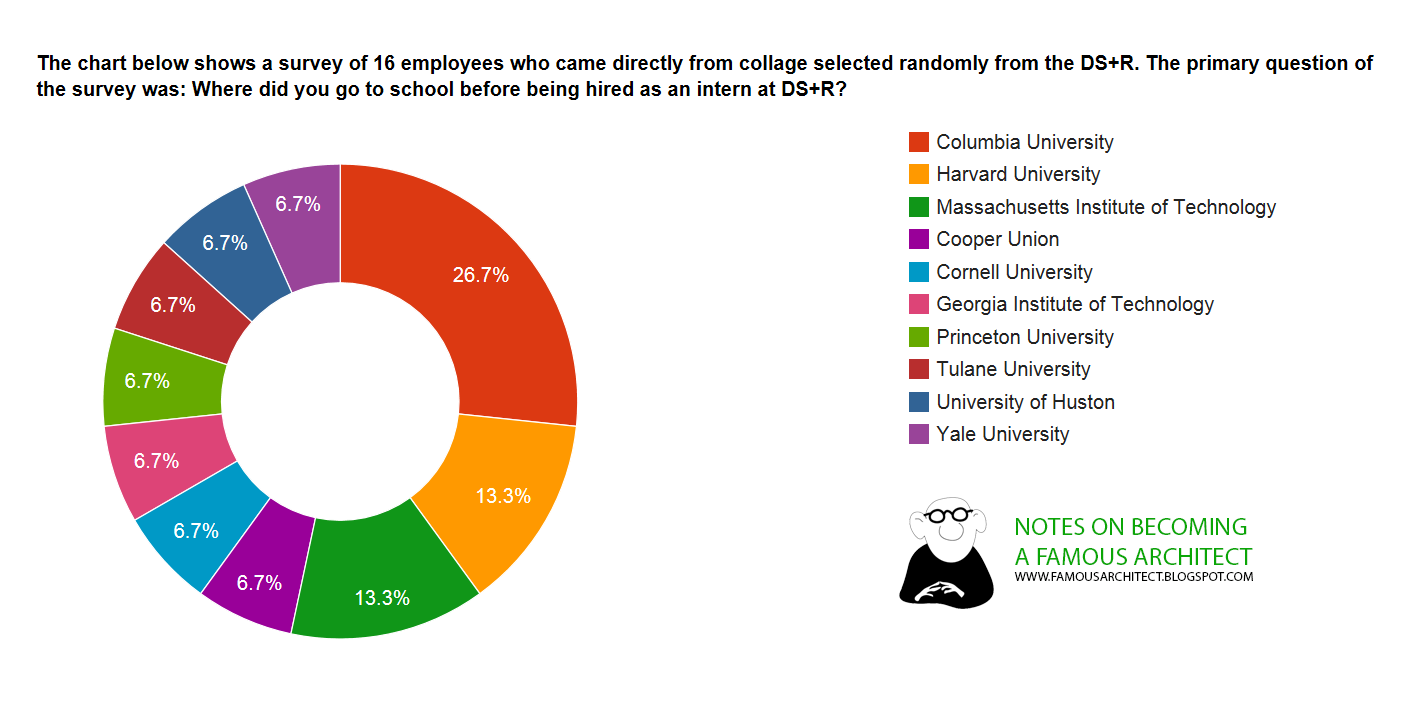
 
 
As stated, a starchitecture school is a school where starchitects are professors:
If you are a non-architect civilian and knew absolutely nothing about the culture of architecture and I showed you this chart, you should be able to tell me with reasonable accuracy which schools have starchitects as professors.
 
In this case Renfero has taught at Rice, Parsons the New School for Design, School of Visual Arts, and Columbia University. Scofidio has taught at Cooper Union since 1965. Diller has also taught at Cooper Union in addition to Columbia University, Princeton University and Harvard University. It is no coincidence that Columbia University is at the top of the list.
 
As you can also see for yourself, basically all Ivy League schools are represented in this tiny sampling of interns. So your chances of getting into the club is significantly increased by going to one of these starchitecture schools. This is regardless if you want to work for DS+R or any other starchitect firm. I am unfairly focusing on DS+R because I have data collected on them from my prevoious notes. However, this is the norm throughout the starchitect industry.
 
This information would be great to know if you were in high school so you can choose the school beforehand. The interesting thing though is that most kids in high school who dream of becoming an architect do not dream of becoming a stararchitect. However, once you are in a starchitecture school you are indoctrinated with the idea that the only honorable recourse after leaving school is to become a starchitect.
 
So this note by default is for students who are already in starchitecture school. The good news is that you are halfway there. The bad news is that you only have a 2% chance of entering the Starchitect Staffers Club and a 0.001% chance of becoming an actual starchitect.
 
You like to gamble?
 
Lets roll the dice then, this is not a game for the cautious and sensible.
 
You are not like the hundreds and thousands who have failed before you. No!
You are special, these stupid statistics and laws of probability do not apply to you.
 
In the voice of the great General Douglas McAuthor - cigar in mouth and all: “I like your spirit lad!”
 
Here are 5 tips to increase your odds:
 
Give up this cock-a-manian obsession most architecture students have about finding and developing your own architectural signature, and style.  
bla, bla, bla. it is stupid! get over it. By the time you wake up from that coma, the train will already be gone. Read my post on starchitecture school. Your sole purpose in starchitecture school is to illuminate your starchitect professor’s ideas and theories and make him look good and proud when he has final reviews and discuss your project with his colleagues. Thoroughly research his every project and theories beforehand and on the first day of class get ready to reinterpret them magnificently.
Read note # 63. What is important in STARchitecture school

Give up this cock-a-manian obsession most architecture students have about designing a functional building that could work in the real world.
This is not what starchitecture school is about. It only has to be functional in proportion of the idea that it discusses or as functional as your starchitect professor wants it to be. You will learn to do all this stuff when you get to work in an office. So just calm your anxiety about this, its not so special. See note #84.You Don't Have to be Good - Part 3: It's about the Idea Stupid! 
and note #86.You don’t have to be good part 4: Form follows Taste.

Be outstanding.
This is the first prerequisite to becoming a star. There is never a star-architect that is just ordinary. If you have a special skill, or talent, or aptitude or whatever that can separate you from the rest of your classmates in a positive way, then use it.
  • Are you from somewhere exotic,?
  • do you have mad skills in a particular program?
  • are you a model making wizard?
  • can you speak eloquently about your work?
  • have a certain sex appeal?
  • an air of sophistication about you maybe?
These are all things that can actually help increase your odds. Use that as your foundation and build from that. As the saying goes: if you got it use it.

Now I know some people are going to write me and say "hey Conrad you mean to tell me that I have to use my sex appeal instead of just making good work?".
Hear me and hear me good. This is not what I am saying; being aware of these things is not a substitute for making the best work you can.

The correctness of the architecture culture would have you believe that a person is evaluated solely on the merits of the work that they produce. This is nonsense!
The work you produce is just the tip of the iceberg. You are evaluated on every aspect of your being that the senses can grasp. Your eye, skin and hair color, your smell, voice, accent, attitude, smile, punctuality, ability to listen and respond to criticism, your learning curve, social skills, economic background, any rumors about you, everything and i mean every gad-damn-thing you can think of.

You have to be aware of these things and project the most positive aspects of them all the time. To ignore this and pretend that it is only what you produce as architecture that is taken in to account when you go forward with your career is grossly naive.  As I am telling you now, your architecture career starts the first moment you walk into the architecture studio and create that first impression on your classmates and professors.
 
Ask!
never mind all your timid stuttering overly childish and critical classmates that might giggle and talk behind your back. Go up to your star-architect professor and ask him for an internship. Don’t wait to be asked, you just might get him on a day when he is in a good mood. If you don’t ask at some point your chances of getting in the club is nil. Remember, if you do it while you are in school, you can apply again and again, if you don't get a yes the first time. However, you only get one chance of applying for internships after graduating.  If you wait until then, your odds become close to nil as well. Do the math!
see note #69. Be Shameless about Asking for things

Work for Free
Give up the idea that working for free at a starchitecture firm or an up and coming firm is a form of exploitation. I will discuss this in more detail in a later note. Take my word on it for now and just consider it an obligatory entry fee into the Starchitect Staffers Club©. See the starchitect business plan at the top of note #100 for some typical contract terms you might expect.

Conrad Newel
Liberating Minds Since August 2007

Thursday, December 11, 2014

100. Diller Scofidio + Renfro and The Star-Architect Staffers Club

This is a loose working outline for the business model of the star-architect office:

  1. Create spectacular head turning projects and publicize them like crazy to get attention and attract clients, but most importantly to attract talented apprentices/interns to work for free.
  2. When the resumes start pouring in, negotiate for free labor: make offers along these lines:
    • “Help us on this competition and if we win, we will hire you” or...
    • “Work for us for free and we will help you get a job at another star-architect firm where we have good contacts”
  3. As you will experience high turnover rate on your interns, maintain a small group of partners or loyal employees as the core of the company and use intern help to become the major production drivers.
  4. Produce more head turning pieces of architecture to attract more attention, and more interns.
  5. With more interns at your disposal, use this resource to increase the volume of competitions that you can enter.
  6. At this rate you are almost certain to start winning some of those competitions and your company's star will begin to rise
  7. With better name recognition and more experience, you can make better quality competition entries and attract even better talent (preferably from other star-architect offices). This is the tipping point where the table turns. At a certain point you will only look at resumes from people who have worked at other star-architect offices. And if you are really good, you can set the bar even higher.
Here we can see an example of an incredibly high bar: Diller Scofidio + Renfro will not consider your resume unless you have worked on at least 4 museums, or equivalent. This effectively means that if you have not worked for another star-architect then do not apply. Why? There are virtually no non-starchitecture firms in the world today that can offer an employee the opportunity to work on the design of a major museum or cultural projects, let alone 4.


Even more... Lets say you have worked for another star-architect firm and you only did residential work, according to this template you need not apply.

So who should apply then?


Most of the employees of the star-architects in this film are eligible to apply to Diller Scofidio+Renfero and likewise DS+R employees are also eligible to work at any of these offices.
 
So what we effectively have here is a kind of a Schengen Zone within the architecture world: a group of elite starchitecture firms that functions almost like a single firm with an interoffice employee exchange.  While most other star-architect offices are less explicit than DS+R about their prejudices and discriminations, they mostly operate with a fairly similar set of qualification criteria.  I like to think of it as the establishment of a Star-Architect Staffers Club©.  By screening resumes in the way that DS+R does, they forge an effective way to identify members of this club and create a kind of inter-office-network with other starchitecture firms, while simultaneously creating a protective buffer against applicants from non-starchitecture firms.
 
The chart below shows a survey of 16 employees selected randomly from the firm. The primary question of the survey was: Where did you last work before being hired at DS+R?


As you can see almost every last one of them worked at a starchitecture firm or an up-and-coming one.

So what are the implications of a Star-Architect Staffers Club?
 
Luca Silenzi wrote a very interesting article Know your [archi-]meme (published in the March 2012 issue of  Domus) where he describes some of the implications and consequences that results when you have an inbred culture within the architecture world. (Incidentally he references note #73 of this blog Work for Rem in his arguments.) He argues that "Global architecture, is becoming more and more similar to itself." Among other reasons for this, he cites "global network" and "same background" in describing the staffers of these firms. He details how the staff of OMA are directly or indirectly inoculated with encyclopedic amounts of information; approaches, working methods, etc. simply by working in that environment. These ideas or memes move with these staffers when they move on from the parent firm ( in this case OMA) and are replicated elsewhere around the globe.
I would also add that it spreads a certain culture with its own set of values, procedures and norms that are accepted globally within these firms. This is not dissimilar to the codes of conduct and corporate culture you may find across both Wall street and the London stock exchange-  the main visual difference here is that the formal corporate garb of the suit and tie are replaced by black or hipster clothing. The values are similar;

-to become a lean well oiled machine for making the most money in the case of wall street and
-to become a lean well oiled machine for winning the most competitions in the case of DS+R and others.


It is interesting to look at the values professed by the founding partners as late as 2009 in contrast to the values they have absorbed up till now. The statements below are taken from an interview that they did with Charlie Rose that year (the full video and partial transcript can be found in note # 59 of this blog Take a Lesson from Diller+Scofidio+Renfero:

Scofidio: Before Elizabeth and I started working together, I had been at another practice, and I had been really sour with the way the profession of architecture was approaching jobs, work and getting commissions. It had nothing to do with issues of architecture. It had to with: I have to produce an income, I have to get work, I have to stay alive.

Diller: We were always a research studio. We were always interested in research whether the outcome was in the form of an installation, in the form of a book, or ultimately in the from of a building. They were just iterations of different forms of the same ideas.

By hiring only people who can demonstrate that they have designed museums and cultural buildings says more about what DS+R has become than any of the two statements above. For one thing it says:

"we are an organization that is about getting museums and cultural building commissions"
or 
"We are a machine for doing that and there is no place for you here if you can not be a gear in this engine".
 
I hate to point out the obvious, but isn't that exactly what Scofidio claimed to have been soured by in the statement above?

Secondly, if you are a research studio and you are interested in research whether the outcome is in the form of an installation, a book or ultimately in the from of a building, then why are people that are particularly skilled in the design of museums and cultural buildings better qualified for these diverse outcomes?

The best explanation here is that DS+R are in the latter stages (stage 7 ) in the star-architect business model that I described in the opening statement of this note. Gone are the days of crazy experiments, exploring the boundaries between art and architecture, high employee turnover, etc.  This has become a firm almost entirely dedicated to one highly specific commercial purpose: winning starchitecture competitions.

Now don't get me wrong, winning competitions is not a bad thing and being efficient at it by hiring people that are experienced and proficient at it is certainly a good idea. Who doesn't want to work with good experienced people?

My critique of this practice is the exclusivity, not in quality, but in the lack of diversity. Here is another statement they made in that same interview:

Diller: Sometimes we were thought of as just wanting to be on the periphery; a decision to want to lob grenades from the periphery at architecture critically...
when we had a chance to do this building, (the ICA Boston) for many people it was a kind of a wake up... for us it was a kind of validation.

Scofidio: Before that we did theater, performance, installations, and a lot of architects accused us of not being able to deal with compromise, not being able to deal with difficult issues of construction. They thought we were taking the easy way out. They kept saying "wait till you do a building... you will see".

Charlie Rose: And what did you find out when you did a building?

Scofidio: The problems are there in everything you do whether you do a drinking glass (which we have done for water), there are complex problems.

Do you see the perplexity and contradictions in their hiring practice?
It becomes even more pronounced in contrast to statements like the ones above. If the problems are the same from a drinking glass to something as complex as a museum why not hire a diversity of quality people. It would follow that your website would say something like:

 "we are interested in quality people from all disciplines; industrial designers, architects, costume designers, artists, etc"

Where is the compromise? Where is the middle ground between being a critical practice and being an established firm? Shouldn't your hiring and staff constitution reflect that?
To me the ominous voice of your critics saying "wait till you do a building... you will see" seems to be particularly prophetic. The validation here seems to be now a validation for the critics not the other way around.


Conrad Newel
Liberating Minds Since August 2007


Tuesday, July 10, 2012

86.You don’t have to be good part 4: Form follows Taste


So in the last note in this series, I concluded that idea is king and that it trumps everything in contemporary architecture.  In other words, if your idea is interesting enough, you can bypass quality construction and rigorous design. So in this note, I will start with the question: 

What else is trumped by idea?

One of the first things I immediately thought about was this interview with Peter Eisenman.

In this video from  7 (Seven) Deconstructivist Architects, Eisenman’s arguments gives a sense of how he sees architecture: as a medium to express ideas even if it means subordinating function, people and wholeness to it.


When we think of stability in our society we think of architecture, for example when I work with Jacques Derrida, Jacques always say to me:
“What about people...but what about the functions”
and I said;
“what do you mean what about the people?... Do you ever worry about people who read your books?”
He said;
“no, those were books, this is architecture, this deals with shelter comfort things like that”
and I said;
“that's a really funny thing for the arch-deconstructionist to be concerned with shelter and comfort”
But you see what I said to Jacques was;
“You philosophers are very funny because it's alright for you guys to move the whole telos of the society around, but when it comes to an architect you say: oh no! that's got to stay in place. So that you guys can be radical, [while] architecture remains whole.”

So then the standard counter argument to Eisenman is:
Well if you are reading a philosophy book and you don’t like it, then you can close the book and put it away - even burn it if you like - but with a building, you have to live with it!

That’s my initial reaction as well, but here is another way to look at it: If a client wants to pay Peter Eisenman thousands of dollars to design a building that makes them uncomfortable and they are also willing to pay several millions to build it, then obviously they are motivated by his work and they are getting exactly what they want. That’s their taste.
As long as these ideas are not applied to urban design and city planning, why should that bother me?
Purposely ignoring the idea of form following function, Eisenman created spaces that were quirky and well-lit, but rather unconventional to live with. He made it difficult for the users so that they would have to grow accustom to the architecture and constantly be aware of it. For instance, in the bedroom there is a glass slot in the center of the wall continuing through the floor that divides the room in half, forcing there to be separate beds on either side of the room so that the couple was forced to sleep apart from each other. 

Upside down stair.


If you are of conservative taste don’t worry, this is a conceptual house built with the aim to spark discussion and debate about ideas. Don’t look to see anything like this as the future of housing.

Personally I am not convinced by the argument that Eisenman makes which essentially states that architecture is kind of like infrastructure in the sense that no one really pays attention to it. It is just there like background music in a film. In order for people to pay attention to architecture it has to basically confront them, do something unexpected, and make people uncomfortable. In doing so, they will be forced to pay attention to it and ask why? Why is this door placed in such an odd way, why is this building element sticking out like that? And so on.

To be honest, that does not inspire me to go and take up a book and read about deconstructivism. It would just annoy me. But that’s just me.

Eisenman however, makes a good point: Functionality is not, or should not be the end-all and be-all in determining architectural form. Neither should it necessarily be the most dominant issue in evaluating a work of architecture.

Another way to say that is: in architecture, ideas should be free to transcend function and comfort.

If we take this argument to its logical extension (...and especially in light of the previous notes in this series) then ideas should also be free to transcend just about anything: Quality construction and even good space.

I should at this point say that Eisenman's attempt to liberate form from function is not the same as Bjarke Ingel’s attempt to liberate form from quality detailing and construction or SANAA’s attempt to liberate form from quality space and rigorous design. Eisenman’s attempts are deliberate where Bjarke’s was more out of carelessness or capitulation to commercial interests and SANAA’s was more out of either laziness or timidity.

But to get back to Eisenman’s point: Form does not necessarily need to follow function in the strictest sense of the word.

Look at this chair below:


It is a very functional chair: It is a recliner chair with electric recline and massage features. This is perhaps one of the most comfortable chairs money can buy. Just look on the ear-to-ear smile on that lady’s face.

However, in my view, that chair reminds me of something I would find in my grandmother's home. It is not my style and I would not buy it or have it in my apartment.

Now look at these other chairs below:

It is called the One&One chair designed by Konstantinos Pamporis and is basically formed of two distinct pieces and based on the concept that each of the pieces symbolized one person in a relationship.

“The idea behind this project was to create a piece of furniture that symbolizes the relationship between a couple. A relationship is only possible when there exists dependence. The elements that come with dependence are “faith” and “risk”. Because of that fact, one chair has only on one side a leg which makes it automatically dependent on the other one. As soon as you become dependent on something we can talk automatically about might!” 


These are rather elegant in my opinion, and the concept is delightfully poetic, but I would not want to sit on it, especially the one with the pink edges.

Just like Eisenman’s house, this is a concept project.

These two sets of chairs represent two extremes in a goldilocks scenario.

  • The first one is was way too conventional; it discusses only function and lacks qualities of ingenuity, playfulness, or experimentation. It is too parochial for my tastes.
  • The second sits in the other extreme, it discusses a poetic idea but the notion of comfort and functionality is all but destroyed (albeit deliberately) as a byproduct of the concept.
My ideal chair sits somewhere in the middle of these two extremes. And that’s my point here; I said “my” ideal not “the” ideal.  And there in lies the heart of the matter. It is taste that drives ideas: Form follows taste.


Form does not have to follow function and the most important thing is not necessarily to make the most functional and user friendly everything. Sometimes it’s okay to give up some level of practicality or certain physical comforts for visual or other ones. It is something we all do whether we think we do or not.


How far we are willing to compromise practicality, functionality, good craftsmanship or quality construction for ideas (whether they are visual, philosophical, sociological, esthetic, etc) depends largely on our own personal taste. Consumers of the Mountain Dwellings would much rather give up some of the virtues of quality detailing for the cool and chic that comes from living in a BIG designed apartment, while the people behind The New Museum probably have no idea of what a quality and rigorously designed space looks like even if it fell on top of them like a brick, but they most likely do care about having the white hot Japanese design duo’s name behind their new building and are duly reaping the hype and publicity that comes along with it.

The craftsmanship and quality of the building itself are just there as a supporting substrate for your ideas. As Eisenman pointed out, this is all like infrastructure, stuff that nobody really pays attention to (maybe except for pesky little bloggers like me). What really matter are your ideas (and by logical extrapolation your taste).

Tuesday, May 1, 2012

84.You Don't Have to be Good - Part 3: It's about the Idea Stupid!

Looking over the previous two post in this series - Mountain Dwellings and the New Museum - I was contemplating on the idea of quality (...or lack of it ) as seen in these two famous works: Lack of quality detailing and construction in the Mountain Dwellings and lack of spatial quality in the New Museum. So then I remembered this statement by Mies.

 First of all, I was influenced by old buildings. I looked at them, people built them. I don't know the names, and I don't know what it was . . . mostly very simple buildings. When I was really young, not even twenty years old, I was impressed by the strength of these old buildings because they didn't even belong to any epoch. But they were there for one thousand years and still there and still impressive, and nothing could change it. And all the styles, the great styles, passed, but they were still there. They didn't lose anything. They were ignored through certain architectural epochs, but they were still there and still good as they were in the first day they were built. 
The notion of building architecture of lasting quality that he so eloquently described is a very nice idea. It is an idea that I think has escaped a great many of the celebrated architects of our generation. Instead of building monuments to the ages, they seem to be more preoccupied with building monuments to the fleeting moment.

Compared to some in the previous generations of starchitects (Mies, Kahn, Scarpa, Barragan, etc) I think that quite a few of our present generation’s celebrities have sidestepped the notion of quality in the discourse of their work. I am picking on BIG, JDS, and SANAA because I have been to their work and have experienced it for myself, but I suspect that it is a wider phenomenon beyond those stars. I would even argue that it spans beyond architecture and is equally prevalent in other fields such as industrial design. For example, there was a time not long ago when the things that you bought in the store had lasting quality. So much so that that they could outlast both you and your children. It would be normal for people to inherit a cherished product from their parents that they could then pass on to their own children.

Do you remember those days?
Perhaps have you are in possession of such a product?

Of course not, you're too young. Watch the clip below: ( this is how consumer-products used to be, quality-wise).


Now consider this: If that golden watch was made with the same level of detailing and craftsmanship as the VM apartments or the mountain dwellings were designed and made with, how long would you give it to survive up Christopher Walken's ass?

I didn't think so either.

Here is another thing to consider: if Apple were to come out with an i-watch tomorrow, would you imagine wanting to pass that down to your children as a birthright, let alone going through any lengths to ensure that it reaches them?

The standard defense of high-tech low-quality creations is that technology is developing so rapidly that it doesn’t make sense to build things that last for a lifetime. I understand this argument but it is nonsense. Apple could make products of lasting quality, but instead, they chose to make products that are close to disposable. Their products are designed to last for about 3-4 years so that you are forced to constantly buy new ones. My i-phone that I bought 3 years ago is not compatible with a great number of apps on the itunes store and it is almost worthless. Apple does this because they are really not bothered by the idea of having an umbilical cord attached to your wallet.

The technology-moving-too-fast argument does not hold water. I can think of several products that were built in yesteryear that was designed with special care that I can still use and enjoy today; products that gets better with age even though the technology is from another era.


This old record player for example, has a distinct aesthetic quality onto itself both in its sound and its physical design. Not even the latest and most advanced i-pod with the most sophisticated surround sound speaker system can measure up to it, even though it’s technology is mortally outdated.


This BMW from 1938 could never ever go anywhere near as fast as the current models with all their climate control, GPS navigation system etc. but it’s design has made it a thing of lasting quality. I am not a fan of cars and I never was, but it is not very difficult to appreciate and be attracted to the quality and craftsmanship that goes into its making.


This industrial Vornado electric fan built in Wichita, Kansas in the 1940s/50s by the O.A. Sutton Company was not an expensive luxury item like the BMW above. It was just a elegant and thoughtfully designed object. The chips and scratches that it has developed over the years have only added to it’s character.

The technology-moving-too-fast argument is even weaker when we take it back to architecture. The Maison de Verre designed by Pierre Chearu in 1928 is an example of architecture integrated with the technology of its time. More importantly it is an example of quality detailing. Since he started out as a fine furniture designer, Chearu approached the design of the building as such. The result is a meticulously crafted building where even the furniture was designed and integrated into the building. I wouldn't say it was good as the day it was made, but for something close to 100 years old, it's not too shabby.


The simple truth is that quality design and craftsmanship transcends technology.

 So here is my question:
  •  How can some of the most celebrated architects and designers of our time get away with designing works of such low-quality again and again and not only come away unscathed, but win multiple design awards and accolades for them time and time again? 
  • Why is it that no one is saying anything about the quality? 
There are many layers of reasons that I will cover in the upcoming series of notes. For now, I will discuss the one which I believe is the most relevant. The clue can be found in starchitecture school. If you ever remember sitting in a crit and seeing the reaction when a star student present and compared it with the reactions later on when a regular student present, then you will get what I am saying.

When a star student presents an eye popping project that has little relationship to reality, their professors tends to smile and discuss the novelty of the idea, while when a regular student presents a less spectacular project that is well considered in relation to real world concerns, he gets questioned on all the nuances of his details.

This is simply because the critic responds to the prevailing ideas and themes that the project discusses. They respond to how you talk about your work as much as the work itself. Unless you have made some really obvious mistakes that is so distracting from the idea of the project that it can not be ignored, quality will not be discussed.

If the principal architectural idea of your project discusses an issue rooted in reality, then you will be critiqued based on the rules of the real world. You will be asked questions like:
  • How do you deal with the structural issues?
  • That building is right across the street from where the local crack addicts hang out. How do you then deal with issues of security, etc? 
However, If you locate your project in the imaginary world of Harry Potter, for example, then it discusses the world of Hogwarts and wizardry. You will be critiqued based on the rules and reality outlined by J.K. Rowling.

You will not be asked about ventilation, crack addicts, security or how your building engages activity on the pedestrian level. Your professors will discuss how the phenomenology of wizardry permeates contemporary society and its ramifications on urban space. And if you are in a real star-architecture school, they will discuss these issues among themselves in front of you as though you are not in the room. Therefore you will not be asked any questions.

Lebbeus Woods once said that architecture is about ideas. He is right!

The significance of your project lies within the ideas that it discusses. Similarly, famous buildings are usually famous because of the ideas that they discuss.

The Maison de Verre by virtue of its high attention to detail and craftsmanship sets up a framework to discuss the idea of quality and craftsmanship. In a critique or discussion of this work, one will tend to discuss the choice of materials, the types of hinges he used or the placements of the elements in relation to the body and such.

Conversely, if the conceptual idea is not directly about quality or the materials, then quality, space, materials, aging etc is secondary and therefore treated accordingly.

The prevailing ideas behind BIG’s projects, for instance, are generally about taking two or more traditionally independent programs and merging them together to make an interdependent hybrid that benefit from one another. Its about parametric design and not the least, it is about engaging commercialism and economy as a robust feature of their design and branding strategy. The most important thing in these projects is to demonstrate that this concept works at least at a basic level, that it appeases commercial interests and that it looks good enough (at least on the opening day). Long-term quality and detailing is not unimportant, but it is less so relative to the larger issues and concepts at work here.

With the New Museum, the main idea is about challenging the way we think about vertical construction. Again as with the VM and Mountain Dwelling Project, the most important thing about the building as far as its relevance in the larger discourse in architecture is to demonstrate that it can be done. It cements an idea in place and time. When historians, academics, students etc discuss and write about the issue of vertical construction in architecture, it will stand on the timeline of critical references along with Louis Sullivan’s Wainwright building, the Seagrams building, etc In this scheme, spatial quality and outstanding detailing is not unimportant but it is less so relative to the prevailing issue of verticality, and the sculptural iconography of the building’s exterior form. Unless it is underperforming in a major way, quality is not an issue.

By contrast, if you look at Meis’ branding strategy and philosophy (prevailing ideas), you will see that it is all about projecting integrity and quality. He derides any notions of temporality (the styles, fashion, etc), he wants to talk about the longer arc of time, material integrity etc. This is where he situates his work and this is what his brand is all about. Below, he talks about his philosophy (and please do not get hypnotized by his branding machine - take it for what it is - an honest observation smothered in promotional whip-cream):

My architectural philosophy came out of reading philosophical books. I cannot tell you at the moment where I read it, but I know I read it somewhere, that architecture belongs to the epoch and not even to the time, to a real epoch. Since I understood that, I would not be for fashion in architecture. I would look for more profound principles. I was lucky enough, you know, when I came to the Netherlands and I was confronted with Berlage's work. There, was the construction. What made the strongest impression on me was the use of brick and so on, the honesty of materials and so on. I never forget this lesson I got there just by looking at his buildings.

If you look at say his Farnsworth house for example, (as with the Mountain Dwelling and the New Museum) the most important thing about the building (as far as its relevance in the larger discourse in architecture is concerned) is to demonstrate that this concept-philosophy can be materialized in the real world. However the core of this concept was about materiality, timelessness, and quality. So to demonstrate that, it had to be designed and built in such a way that it can withstand aging without losing its integrity.

Long term quality, and detailing is at the center of this philosophy. So if any of Mies’ buildings were made nearly as poorly as the Mountain Dwellings or the VM apartments it would have probably been ruinous to his career and reputation. Conversely, if any of Bjarke’s work were as famously over budget in the way Mies’s Farnsworth house was, it would probably ruin his reputation too.

So what’s my point?

The prevailing ideas of your work and branding trumps all. In the grand scheme of the fame game, quality in material and craftsmanship, even fundamental things like quality of space are simply subordinates to ideas and branding. For celebrated works, they are dispensable attributes, not fundamental prerequisites as I previously thought. So, allow me to retort with the title of this series: You don’t have to be good.


Conrad Newel

NOTES ON BECOMING A FAMOUS ARCHITECT
Liberating Minds Since August 2007


RELATED NOTES:
83. You Don't have to be Good - Part 2: SANAA & The New Museum
82. You Don't Have to be Good - Part 1: BIG, JDS, PLOT


Monday, May 16, 2011

77. Professional Success vs Personal Development

Milton Glaser is the graphic design world’s closest equivalent of a star-architect . Here he talks about the differences between professional success and personal development. It is directed towards young artists but the lesson is just as applicable to architects as well.


Professional Success vs Personal Development

In professional life you must discover a kind of identity for yourself, that becomes a sort of trademark; a way of working that is distinctive that people can recognize.

The reason for this is that the path to financial success and notoriety is by having something that no one else has. Kind of like a brand ( one of my most despised words)

So what you do in life in order to be professional is develop a brand, your way of working, your attitude that is understandable to others.

In most cases, it turns out to be something fairly narrow...

..and then you discover you have something to offer that is better than other people have, or at least more distinctive.

And what you do with that, is you become a specialist.
Then people will call you to get more of what you've become adept at doing.
So if you do anything and become celebrated for it, people will send you more of that.
For the rest of your life, quite possibly, you will have that characteristic and people will continue to ask you for what you have already done and succeeded at.

This is the way to professional accomplishment: you have to demonstrate that you know something unique, that you can repeat, over, and over and over until ultimately you lose interest in it.

The consequence of specialization and success is that it hurts you. It hurts you because it basically doesn't aid in your development.

The truth of the matter is that understanding development comes from failure. People begin to get better when they fail. When they move towards failure they discover something because of it. They fail again and they discover something else. So the model for personal development is antithetical to the model for professional success. As a result of that, I believe that Picasso as a model, is the most useful model you could have in terms of your artistic interest, because whenever Picasso learned how to do something he abandoned it. As a result of that, in terms of his development as an artist his results were extraordinary.

RELATED NOTES:


  • 14. Do Good Work & Keep Your Soul


  • 15. You have to work at it
  • Tuesday, August 17, 2010

    69. Be Shameless about Asking for things


    I am going to tell you a story which may disturb you, or even more, completely discourage you from what I am about to argue for, but its a good little story and I will tell it anyway. Who knows, if you are still convinced of my argument after this story then I believe you are truly material for being a famous architect.

    Back in the days when I was in collage, I had an interesting classmate named Andrew. Almost everyone in the studio seemed to have a certain aversion towards him. Very few actually described him as a friend, and even these so called friends of his always seemed to have a problem with him. It is difficult for me to count the amount of times a friend of his would come up to my drafting table and start a conversation that begins with the phrase "Andrew is my friend but..." and then continue on to tell of the latest conniving thing that he did to them. The other problem with Andrew was that he walked around the studio with a certain air of superiority about him. If you met him at a party and had a brief conversation with him, chances are you would walk away with the impression that you are somehow beneath him.

    The most interesting thing about Andrew though is that he always seems to have people granting him all kinds of favors, or doing something on his behalf, or giving him something. Even me!. The lesson of Andrew is that he was never afraid to ask for help or for anything. In fact he was downright shameless about it. It would not matter if you were laughing with him or arguing with him, there was no wrong time to ask in his view. If he needed help with anything he would just come right out and ask. If you just bought the latest CD, he would ask if he could copy it. If you just bought the latest gadget, he would ask if he could borrow it. If a starchitect was teaching the course, or visiting for a lecture, and he wanted a job at that office, he just went right ahead and asked.

    I remembered Andrew because I had a realization just the other day, and that realization this:

    Famous Architects are unashamed to ask for things.


    They are not afraid to pick up the phone and ask. They ask of their employees, they ask of their colleagues, they ask of their friends, they ask whoever they see fit and they do it all the time. They do not hesitate, they do not waste time agonizing over it, they just do it. When ever they need something, they make decisions quickly, pick up the phone and get on with it.

    So you might say “oh, they are used to it, because they have many people working for them so its just something they got used to doing”.
    Well, I am not so sure about that. In fact, I don’t think so. I think they got an office, and employees, and became famous because they had no issues with asking for help or for anything.

    I had the great fortune (or great misfortune, depending on how you look at it) of either being taught by or working with quite a few famous architects. I also know quite a few rising stars.

    I can say with complete certainty that this is one of the few traits that connects all of them, no matter how different their works or philosophies.

    One friend of mine whom I worked with on a project some time ago is a rising star. For reasons of privacy I will simply refer to him as Joe. Joe learned through a friend we have in common that I was working on a project that was potentially beneficial to his office and would give him some free promotion. Immediately he contacted me:

    “Hey Conrad, how is it going?

    I had a conversation with Jenny, she said you guys are working on this project... bla bla bla bla ...

    Of course I suggested my office could be involved as a participant.

    She suggested I talk to you.

    Maybe you could work out something for us?

    And here is how it could benefit you too... bla bla bla ...

    What do you think?”


    “Yeah, sure” I answered,

    “I will just suggest it to the rest of the guys on the team and see what happens”


    Reflecting on the conversation some time later, I thought about how it would be if it were the other way around? What if Joe was working on a high profile project and I saw that there could be some free publicity in there for me? What would I do?

    Well before I figured out how to ask, before I learned what I am about to tell you, my train of thought would have looked something like this:

    • Oh, I wouldn’t want to be a bother or impose on him.
    • I wouldn’t want to be patronized, I don’t need that, if I want publicity I will get it when I need it, on my own.
    • He is probably not going to do it anyway, so why bother?
    • That might be too much to ask... I don’t want to put him in an awkward position.
    • What’s this going to cost me? Am I going to be indebted to him... I don't want that.
    • If I ask him, it may seem like I am begging and gosh I don’t want to come off as weak or needy or even worse: desperate.
    • I am a giver; I am a kind giving person and I would much rather give to others than to go around begging and leaning on other people.

    In short, I probably would have talked my self out of doing it. I think most of us would too. I think most people simply don’t know how to ask and that’s a problem. We don’t want to be demanding or leaching like Andrew on one hand and on the other we don’t want to appear weak, especially guys; you know the proud smart self-reliant type that drives around in circles and would not ask for directions because they don't want to come off as incompetent or stupid. I don’t know about you, but driving around in circles with your head stuck up your ass is not exactly my idea of strength, competence or self reliance. From where I stand, it looks more like an image of insecurity and cowardliness, not to mention stupidity. Yet we do this with our careers, and worse we do this with our lives.

    But I have news for you. There is a vast difference between people like Andrew who goes around and take, take, take and never give back and the so-called proud-independent who drives around in circles for hours afraid to ask for help. There is a middle ground between these two extremes.

    Joe is a good example. I learned a lot during the short time I worked with him. Like any emerging firms we usually worked very long hours. Joe would spend the better part of the days on the phone making calls negotiating with people (That's archispeak for asking for help). He did this constantly for hours and hours, it was only later in the evenings that he would seriously switch his focus on to architecture. The other thing that really surprised me was that for a relatively young guy who have worked for some of the most celebrated starchitect offices around the world, he did not have some basic skills that you would expect from a person with that caliber of experience. For example, he did not know how to render and his photo-shop skills were a bit shabby. But that did not seem to get in his way. He was adept at delegating and readily acknowledged when he did not know something instead of pretending to be an expert. He was driven and motivated and when things got tough he asked for help right away.

    What Joe lacked in photo-shop and rendering skills he more than made up for in asking skills. This is the single most important skill I learned from him and I would like to share it with you. You can look at that conversation I mentioned I had with him earlier as a case in point. It has all the ingredients of a good way to ask for help.

    Firstly, make sure the person you ask is actually in a position to help you.
    I had a project that could give him publicity and I had some influence over who could be involved in it. So naturally Joe came to me.

    Secondly, Be confident and straightforward
    No I did not say cocky. You should not go around expecting people to do you a favor or help you no matter how much you have helped them before or how good a friend they are or for any reason. Remember you are asking not demanding. At the same time don’t grovel or be wimpy about it. If you go and ask in the tone of voice of Doubtful Tom: “uhm... ahh... you wouldn’t want to help me on this would you?”
    That’s not asking for help, that's a weak prayer or kind of a little psychological trick to prove to yourself that at least you tried. That is not a sincere effort, that’s a cop out. If you are going to do it half assed don’t bother wasting your time. Neither should you try to drop hints and expect the other person to kind of read between the lines. Then what you are doing is trying to make the person you are asking feel guilty and help you out of pity. That’s just lame and manipulative.
    Just get to the point and state in no uncertain terms what you are asking for. You can explain why or argue your case later in the conversation as necessary.
    When Joe asked me, he simply and directly stated what he wanted “could you work out a deal where my office is a participant in your project” no demanding, no guilt trip hints, no groveling, just a clean, clear, honest question. Then he went on to explain how it could benefit me, in other words how this could be a win-win situation. This brings me to the third point.

    Look for ways to reciprocate: read the tone of voice and body language of the person you are asking. Is there a hesitation or reluctance in their answer? If so respond accordingly, remember you are really negotiating a win-win situation. You want to come out with an amicable outcome for yourself and the person you are asking whether you come away with a yes or no or a counter offer.

    Of course there will be occasions where there is no point in offering something in return. Now at the risk of sounding superstitious, I will say this: what goes around comes around. You will find that people will come to you to ask for favors too; maybe not that same person that helped you, but someone else. Help them. Get in the habit of helping other people. Not because you want to build good karma or because you expect something back, but because it is fun. Do it to train your brain that its about giving and receiving. Develop that reputation. Think about the kindest, most helpful or generous person you know. How would you respond if they came to you for a favor?

    Recalling the days I was working with Joe and hearing him “negotiate” on the phone, these three principles were always present in those conversations, whether he was talking to a potential client, another firm he was seeking to partner with on a competition, a contractor, or student he was asking to intern for him.

    And by the way, when the time came that I needed a favor from him and I asked, he was very accommodating and even went out of his way to make sure I got the proper help that I asked for. In fact this is what defines our relationship. Even though we live in different countries now and we don't see or hear from each other for long periods of time, I have no reservations about picking up the phone and asking him for help and he of-course doesn't either.

    Anyway, I will leave you with the final scene from one of my favorite movies: My Cousin Viney. Its about an inexperienced lawyer who has a lot of raw talent but wanted to win his first trial on his own; without asking for help from anybody. In short he wanted to do things the hard way, and unnecessarily hard it was. In the end he begrudgingly received a lot help along the way from his fiancée and others to win his first trial case.


    Conrad Newel

    NOTES ON BECOMING A FAMOUS ARCHITECT
    Liberating Minds Since August 2007